Comparison guide
Shade Sail vs Awning — which is right for your place?
Two very different ways to shade a Kiwi outdoor area. Here's how they compare on cost, weather, wind and looks - from a team that designs, makes and installs both.
Get a Free QuoteThe quick verdict
For most NZ homes: choose a shade sail if you want to cover a large, fixed area - a pool, playground, courtyard or big deck - with maximum UV protection at the lowest cost. Choose an awning if you want shade on demand over a deck or patio off the house: extended on hot days, retracted in winter so the sun still warms your living areas. Sails win on coverage and price; awnings win on flexibility.
The genuine “it depends” factors are how you use the space and what it’s attached to. A sail needs anchor points and shades the same spot permanently; an awning needs a solid wall and suits areas immediately off the house. Site, aspect and wind exposure shift the answer - which is why we always start with a free measure.
Side by side
How they compare
Shade sail
- Upfront cost
- $ - $$. A fixed sail over posts is one of the most cost-effective ways to cover a large outdoor area.
- Weather protection
- Excellent UV cover - Monotec knitted mesh offers up to 97% shade. Breathes rather than sheds rain (waterproof PVC sails are a separate option).
- Wind handling
- Very good. A properly tensioned sail is engineered as a permanent structure and the knitted mesh lets wind pass through.
- Looks
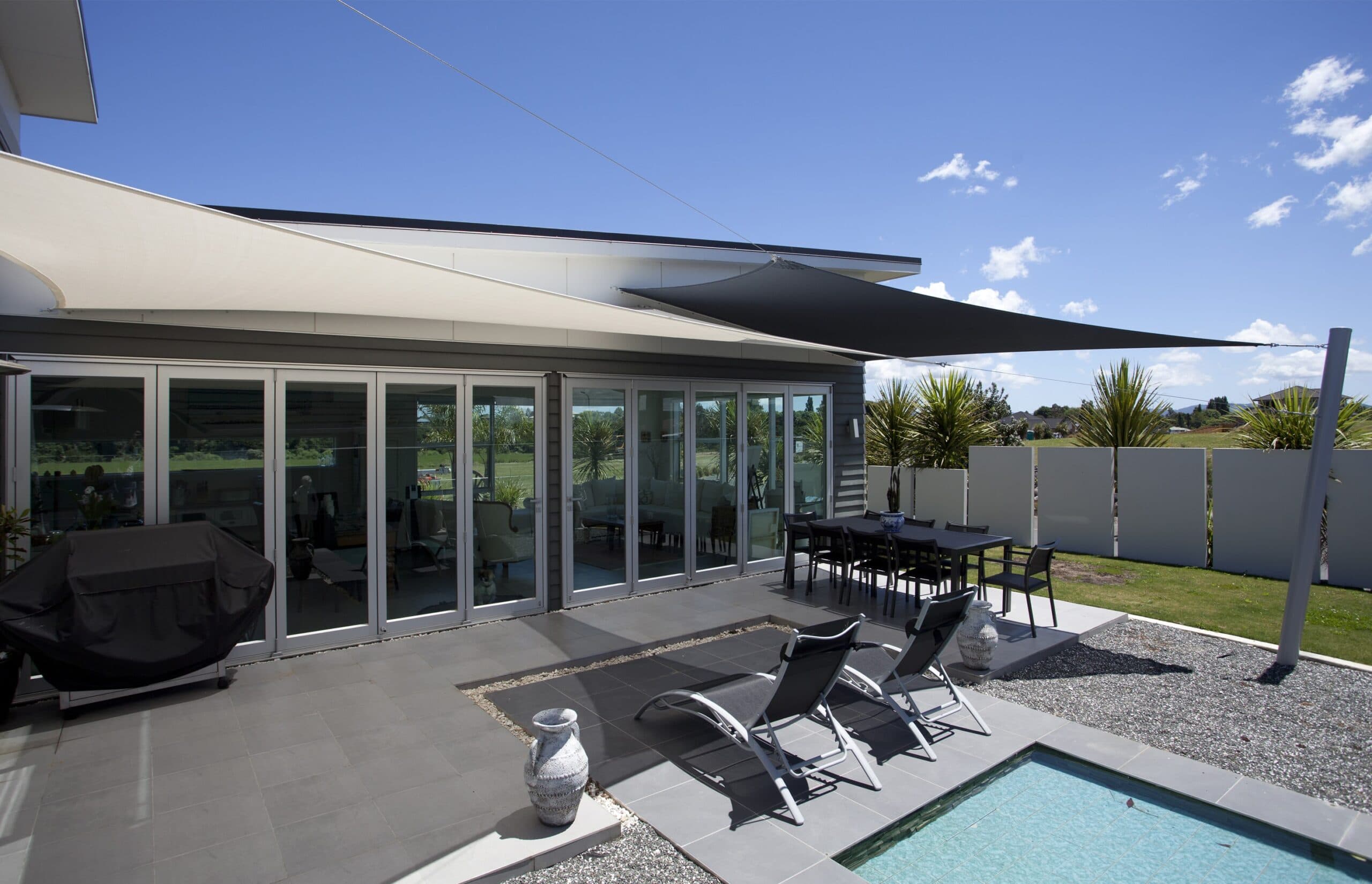
- Sculptural and architectural - sweeping curves in 14-15 colours that can become a feature of the property.
- Maintenance
- Low. No moving parts; the fabric carries a 13 year warranty and occasional re-tensioning keeps it taut.
- Best for
- Large fixed areas - decks, pools, playgrounds, courtyards - where you want permanent summer shade.
Awning
- Upfront cost
- $$ - $$$. A folding-arm system with quality European components costs more than a sail of similar coverage; motorisation adds to it.
- Weather protection
- Strong overhead sun protection that minimises UV and maximises heat reduction - and it retracts, so you keep winter sun.
- Wind handling
- Good with the right setup - Horizon awnings are tested in winds up to 90km/h, and a wind sensor can retract the awning automatically.
- Looks
- Clean and tailored against the house - a neat cassette on the wall rather than posts in the garden.
- Maintenance
- Modest. Moving parts and a mechanism mean a little more care than a sail; 5 year warranty on Horizon and Vertigo systems.
- Best for
- Decks and patios off the house where you want shade on demand - out in summer, away in winter.
The case for a shade sail
A shade sail is a tensioned, engineered piece of fabric - not a tarp on hooks. Every sail we make is custom designed for the space, manufactured in our Pirongia workshop and installed by the same team that measured it. The fabrics do the heavy lifting: Monotec 320 is a high-strength commercial-grade knitted cloth offering up to 97% shade, ideal for smaller residential sails, while Monotec 370 is the strongest shade mesh available and the widest cloth made, which means fewer seams on big spans. Both carry a 13 year warranty and both are 100% recyclable.
Because the mesh is knitted rather than solid, air moves through it - the area underneath stays noticeably cooler than under solid roofing, and wind loads on the structure are lower. That’s why sails are the default choice for pools, playgrounds, school courtyards and big north-facing decks that cook all summer. Corners are finished with either a webbing edge or an adjustable wire edge with marine grade stainless componentry, and with 14-15 colours across the two fabrics, a well-designed sail becomes an architectural feature rather than a compromise. The trade-off is permanence: a sail shades the same footprint in July as it does in January.
The case for an awning
An awning gives you shade exactly when you want it - and takes it away when you don’t. Our Horizon folding-arm awnings are custom made with quality European components and styling, operated by a gearbox handle or fully motorised at the press of a button. Add a wind or motion sensor and the awning retracts itself when conditions turn - the system has been tested in winds up to 90km/h with no visible damage, and carries a 5 year warranty.
The retractable format is what wins people over. In summer the awning extends for overhead sun protection, minimising UV and cutting heat before it reaches your windows and furniture. In winter it sits neatly against the house so the low sun pours in and warms the place for free. There are no posts in the lawn and nothing between you and the view - just a tailored canopy off the wall. For window shading and privacy rather than deck cover, the Vertigo drop-arm awning is the companion product: an adjustable fixed-frame system with sunscreen mesh for filtered natural light or acrylic canvas for a private finish, built from aluminium and stainless steel components. If your outdoor area is right off the house and you value flexibility over maximum coverage, an awning is usually the smarter spend.
Our recommendation
Match the product to how you live outside
Go with a shade sailif you’re covering a pool, playground or a large entertaining area away from the house; if maximum UV protection for kids is the priority; or if you want the biggest shaded footprint for your budget. Sails also suit exposed sites where airflow matters - the mesh spills wind instead of fighting it.
Go with an awningif the area is a deck or patio directly off your living room; if winter sun into the house matters to you; or if you want one-button convenience with a wind sensor minding it while you’re out. And if your real problem is rain rather than sun, neither is the answer - look at a waterproof PVC sail or Ziptrak outdoor blinds instead. We make all of them, so our advice at the free measure is about your site, not about steering you to one product.
Shade sail vs awning — questions
Is a shade sail cheaper than an awning?
Generally, yes - a fixed shade sail is one of the most cost-effective ways to cover a large outdoor area, while a folding-arm awning uses a mechanical system with European components, so it sits in a higher bracket, especially motorised. The honest answer depends on the size of the area and what your site needs, which is why we quote from a free on-site measure rather than a price list.
Which handles Waikato wind better - a sail or an awning?
Both, in different ways. A tensioned knitted-mesh sail lets wind pass through and is engineered as a permanent structure. A Horizon folding-arm awning has been tested in winds up to 90km/h, and when motorised, a wind or motion sensor can retract it automatically when conditions pick up.
Do shade sails keep the rain off like an awning does?
Standard knitted shade cloth sails breathe rather than shed water - they're built for sun protection and airflow. If you want a sail that keeps rain off too, we make waterproof PVC sails with heavier engineering. An extended awning also sheds light rain, but it's primarily a sun-protection product.
Can I get shade in summer but keep the sun in winter?
That's the awning's party trick - it extends for summer shade and retracts so low winter sun reaches your windows and warms the house. A fixed sail shades the same spot year-round, which suits pools, playgrounds and hot north-facing areas that need cover all season.
“We’ve got you covered”
Not sure which is right? Get free advice
Tell us about your space and we'll come out, measure it and recommend the option that actually suits it - with a no-obligation quote.