Comparison guide
Ziptrak vs Cafe Blinds — which should you choose?
Track-guided or traditional? Both enclose your outdoor area against wind and rain - here's where each one earns its keep, from a team that installs both.
Get a Free QuoteThe quick verdict
If you’ll open and close your blinds most days, buy Ziptrak. The track-guided system glides up and down in seconds, stops at any height and locks down against wind - no zips, ropes or buckles. If you’re enclosing a big commercial frontage, a childcare play area, or a space you close in for winter and largely leave, traditional cafe blinds do the same weatherproofing job for less money.
The nuance is frequency of use and span. Ziptrak’s premium buys daily convenience and sealed side tracks; cafe blinds trade that convenience for a lower price and flexibility across wide or irregular openings. Both are made to measure and both take the same core fabrics - clear PVC for weather, mesh for sun and airflow - so neither choice locks you out of the protection you need.
Side by side
How they compare
Ziptrak track-guided blinds
- Upfront cost
- $$ - $$$. The premium tracked system - you're paying for the engineering, and motorisation adds to it.
- Weather protection
- Excellent. Side tracks seal the edges, so clear or tinted PVC keeps out wind and rain all year round.
- Wind handling
- Very good. The blind locks in the down position to guard against high winds - no flapping edges.
- Looks
- Clean and minimal. A taut, flat surface with no straps or zips, plus optional pelmets for a premium finish.
- Ease of use
- The big win - spring-balanced, glides in the tracks and stops at any height. Manual or motorised, no zippers or buckles.
- Best for
- Outdoor rooms you use every day - home patios and decks where convenience and sealing matter most.
Traditional cafe blinds
- Upfront cost
- $ - $$. The more budget-friendly way to enclose an outdoor area, especially across wide or multiple openings.
- Weather protection
- Very good. Tension membrane PVC - mesh or solid - with heavy duty nylon zips closes the space in against wind and rain.
- Wind handling
- Good when zipped down and tensioned properly; the fixings hold the blind to the structure.
- Looks
- The classic hospitality look - also called pergola covers or patio curtains, with visible zips between panels.
- Ease of use
- More hands-on. Panels are zipped and released manually, so opening up takes longer than a tracked system.
- Best for
- Cafes, venues, childcare centres and larger spans - or home areas you enclose for the season rather than daily.
The case for Ziptrak
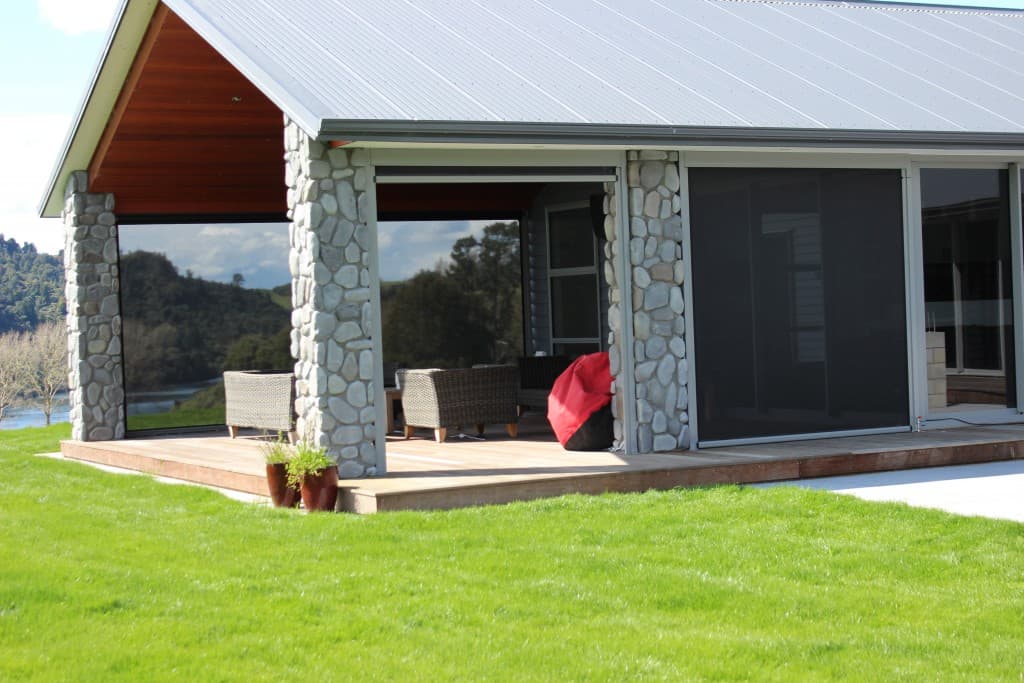
Ziptrak is a track-guided blind system - specially designed slotted tracks on both sides of the blind let the fabric glide smoothly and easily, stopping anywhere you want. Pull down, push up: the spring-balanced design means there are no zippers, ropes, buckles or pulleys anywhere in the system. When the weather turns, the blind secures and locks in the down position to guard against high winds and UV, and the sealed side tracks keep draughts from sneaking around the edges. That’s what turns a patio into a genuine outdoor room - warm in winter, cool in summer.
Fabric-wise you choose what the space needs: clear or tinted PVC to keep wind and rain out while preserving the view, hi-tech solar mesh for sun and UV protection with airflow, or acrylic canvas for total block-out. Operation is manual or motorised, and customised pelmets add protection for the rolled blind plus a tidy, premium look. The taut, flat surface even doubles as a spot for corporate signage on commercial jobs. Ziptrak and Urban Track are the two preeminent tracked systems available in New Zealand, backed here by a 2 year warranty and a large range of quality fabrics that guarantee strength and wind resistance. If the blind is part of your daily routine, this is the one you’ll be glad you paid for.
The case for traditional cafe blinds
Cafe blinds - also called pergola covers or patio curtains - are the proven, cost-effective way to weatherproof an outdoor space. Tensioned membrane PVC panels, in mesh or solid clear PVC, are fixed to your structure and joined with heavy duty nylon zips, closing the area in against wind and rain so you can entertain rain or shine and hold warmth in winter. All fittings are non-perishable, powder coated aluminium, and every set is manufactured to last - we make and install them throughout Hamilton and NZ-wide.
Where cafe blinds really shine is scale and budget. A hospitality courtyard with a long frontage, a school or early childhood centre enclosing a play area, a pergola with wide or irregular bays - panelled cafe blinds handle these spans gracefully and cost meaningfully less than tracking every opening. The trade-off is handling: panels are zipped closed and released by hand, so opening the whole space up takes a few minutes rather than a few seconds, and there’s no stopping halfway. For spaces you set for the season - closed in from autumn, opened for summer - that’s barely a cost at all, and the money saved is real.
Our recommendation
Buy for how often you’ll touch it
For a home patio or deck you use year-round, go Ziptrak - ideally motorised on bigger blinds. Daily up-and-down is exactly what the track system is built for, the any-height stop is genuinely useful against low sun, and the sealed tracks make the space noticeably warmer on a southerly day.
For cafes, venues and childcare centres with long runs of opening - or a home space you enclose for winter and mostly leave - go traditional cafe blindsand put the savings elsewhere. If you’re on the fence, count how many times a week you’d realistically raise and lower the blinds: more than a handful, Ziptrak; less, cafe blinds. We install both across the Waikato, so the recommendation you get at the free measure is based on your space, not our margin.
Ziptrak vs cafe blinds — questions
Why do Ziptrak blinds cost more than cafe blinds?
You're paying for the track system. Ziptrak and Urban Track are the two preeminent tracked blind systems available in New Zealand - spring-balanced blinds that glide in sealed side tracks, stop at any height and lock down, with no zippers, ropes or pulleys. Traditional cafe blinds achieve their enclosure with tensioned PVC panels and heavy duty nylon zips, which is simpler to make and simpler to buy.
Are cafe blinds still a good choice, or is Ziptrak always better?
Cafe blinds are still the right call in plenty of situations - wide commercial frontages, childcare play areas, and spaces you close in for winter and open up for summer rather than adjusting daily. They're manufactured to last with non-perishable, powder coated aluminium fittings. Ziptrak earns its premium when you're opening and closing the space every day.
Can both types stop halfway down?
Only Ziptrak. Its spring-balanced, track-guided design lets the blind stop securely at any height - handy for cutting low sun while keeping the view. A traditional cafe blind is essentially open or zipped closed; there's no in-between position.
What fabrics can I get in each?
Both use the same families of material: clear or tinted PVC for wind and rain protection, and mesh for sun and UV protection with airflow. Ziptrak blinds can also be made in acrylic canvas for total block-out. We'll recommend the fabric based on the aspect of your space and how you use it.
“We’ve got you covered”
Not sure which is right? Get free advice
Tell us about your outdoor area and we'll measure it, talk through both systems and give you a no-obligation quote for the one that fits.